Friday, February 1, 2013

Fun Facts about Dental Implants in Chicago, PART 4

Learn some interesting facts about dental implants in this four-part article series, from their historical conception to their sophistication as a strong and durable tooth replacement technology.

Welcome back to our four-part article series on the historical development and amazing abilities of dental implants in Chicago. Over the course of our previous three article posts, we have looked at some of the incredible facts to be found on this indispensible technology, from the discovery of osseointegration in 1952 to the 98% success rate of modern dental implant procedures. In this article, the final installment of the series, we shall finish off by discussing how far implant surgery has come since the early 1990’s.

Interesting Fact # 7: Dental Implants Can Give Patients New Teeth in One Day

Dental implants in Chicago

In the early 1990’s, European implantologist, Dr. Paulo Malo, developed a dental implant technique that would enable specially trained dentists to achieve the unprecedented in the fields of fixed oral rehabilitation and dental implantology. This innovation, termed “All on 4 Implants” was able to give patients a brand new set of teeth in a single day, with a single surgery. In order to fully appreciate this, let’s take a look at the route for teeth replacement using traditional dental implant procedures.

Let’s pretend that you’re edentulous (don’t have a single original adult tooth left) or are facing an immediate future of edentulism. If you’re reading this, there’s a good chance that this isn’t too much of a stretch of the imagination! Before the introduction of All on 4 Implants, the journey taken to get a complete set of fixed and non-removable teeth placed would require:

  • As long as 18 months for you to get new teeth,
  • As many as 6, 8 or even 10 dental implants per jaw,
  • Multiple surgeries and recovery periods,
  • Bone grafting surgery, which is painful and expensive
  • Over a hundred thousand dollars to finance!

Dr. Malo was well aware of the limitations and challenges of traditional dental implant procedures, especially in the treatment of edentulous and near-edentulous patients. So, he dedicated much time and effort to the development of a surgical technique that would bypass these challenges and, in doing so, immensely cut down on the time and expense required to give patients new teeth. The fruits of his labor are “All on 4 Implants”. Let’s take a look at how they work.

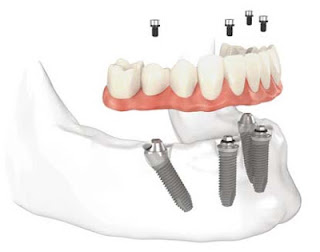
All on 4 implants

The “All on 4” technique essentially consists of the very precise placement and angulation of only four dental implants in the upper and/or lower jaw. A customized prosthetic dental bridge, which looks like a full set of teeth, is then attached to the abutments of these dental implants. The positioning of the dental implants enables oral surgeons to reap maximum support from the jawbone for a set of replacement teeth, even in cases where patients have lost a lot of supporting bone tissue due to denture wearing.

This typically bypasses the need for bone grafting (a massive accomplishment in itself), and because only four dental implants are needed, the entire procedure can be done in a single day, with only a single surgery! This reduces the expense of fixed oral rehabilitation by tens of thousands of dollars, making it far more accessible to a greater number of patients in desperate need of a new set of teeth.

A Final Note on Dental Implants

As you can see from all the amazing facts discussed, dental implants really are a feat of modern dental and medical science. Their abilities are simply unparalleled and yet, with every passing year, implant hardware and surgical procedures continue to be refined and further developed. From the earliest replacement teeth carved out of seashell to modern All on 4 Implants: the science has come a very long way and continues proudly on its upward trajectory!

Wednesday, January 30, 2013

Fun Facts about Chicago Dental Implants, PART 3

Learn some interesting facts about dental implants in this four-part article series, from their historical conception to their sophistication as a strong and durable tooth replacement technology.

Welcome back to our four-part article series on Chicago dental implants and the many interesting facts there are to learn about this important teeth replacement technology. In our previous article post, the second installment of the series, we found out that the key behind the success of dental implant – osseointegration – was actually an accidental discovery made by Swedish orthopedic surgeon, Professor Per-Ingvar Branemark.

This discovery is so interesting because dentists had struggled for many hundreds of years to find a tooth replacement material that could remain permanently rooted in the jaw, to no avail. It took a single accidental experiment in 1951 to reveal the key to permanent teeth replacement and that was titanium’s total biocompatibility.

We also looked at some of the resultant benefits of osseointegration: the ability of dental implants to remain free-standing (independent) in the mouth without the need of support from the neighboring hard and soft tissues, the teeth and gums. Let’s now take a look at some of the incredible feats of modern implant hardware.

Chicago dental implants

Interesting Fact # 5: Dental Implants Promote a Healthy Jaw Bone

You could be forgiven for thinking that surgically inserting a piece of metal into your jaw would be bad for it, but actually, dental implants are essential for the long term health of your jawbone! This is because, unlike any other teeth replacement technology, dental implants replace both the crown and the root of the missing tooth. Think about it: dentures sit on your gums while dental bridges rest on the filed-down crowns of the teeth adjacent to the missing tooth. Both replace the visible portion of the tooth, but not the structures underneath the gums.

The roots of your teeth are essential to the good health of the bone tissue in the jaw, which, just like any muscle in the body, requires “exercise” to remain strong and healthy. By transmitting the forces associated with biting, grinding and chewing into this tissue, the tooth roots do just this. When they are lost, therefore, there is a serious risk of atrophy and this can cause the jawbone to shrink and waste away at the site/s of the missing tooth or teeth.

The long-term consequences of jawbone atrophy are dental instability of the entire tooth row and even further tooth loss. But perhaps most concerning for patients is the fact that the remodeling process of your jawbone can cause premature aging of your natural facial contours: a shocking and terrifying prospect for anyone.

Tooth implants replace both the crown and the root of the missing tooth, which in turn replaces the source of stimulation needed by the jaw to remain alive and healthy. This makes implants the best and most sophisticated teeth replacement solution on the market – one that promotes excellent jawbone health and prevents complex dental problems and premature aging in the long run (see image below).

Tooth implants Chicago

Interesting Fact # 6: Dental Implants are Almost Always Successful

The success rate of dental implants in the treatment of single and multiple missing teeth is incredibly high:

  • In the case of single tooth replacement, the success rate is 98% over a period of 25 to 30 years.
  • In the case of fixed oral rehabilitation (the replacement of an entire arch of upper and/or lower teeth), the success rate is 95% over a 10-year period, without any significant loss of jawbone volume noted.

This is an excellent achievement and surpasses, in lifespan and quality, both dentures and bridges, both of which go hand-in-hand with daily challenges and repeat expenses.

Stay Tuned for Part 4

To read some final interesting facts about tooth implants in Chicago, stay tuned for the final installment of this four part article series.

Wednesday, January 23, 2013

Fun Facts about Tooth Implants in Chicago, PART 2

Learn some interesting facts about dental implants in this four-part article series, from their historical conception to their sophistication as a strong and durable tooth replacement technology.

Welcome back to our four-part article series on dental implants and the many interesting facts there are to learn about this very important technology! In our previous article post, the first installment of the series, we looked at the various materials our ancient counterparts used to replace missing teeth, from gold and ivory to seashell and gemstones. We then talked about the material from which modern tooth implants in Chicago are made - titanium, which is also the same metal from which space craft, military fighter jets and professional golf clubs are made! Now, let’s take a look at just how we made the transition from using crude tooth replacement materials to titanium.

Interesting Fact # 3: Modern Implants Were an Accidental Discovery!

Tooth implants Chicago

The modern dental implants used by Chicago dentists today were actually discovered accidentally! In 1952, Swedish orthopedic surgeon Professor Per-Ingvar Branemark (image above) was working on a clinical research project using rabbit bone and titanium metal. The aim of this research was to examine the blood flow within a rabbit bone using an implant titanium chamber.

Once his experiment was done and all the data collected, Professor Branemark tried to remove the implant chamber, only to find that the rabbit bone had actually bonded with the surface of titanium metal. In other words, the bone tissue had integrated with the implant, essentially making this “foreign” material a part of the rabbit’s body! This breakthrough discovery was called "osseointegration" and it opened up an incredible number of possibilities for medical science that would benefit both humans and animals.

Nowadays, the entire field of orthopedic surgery, dedicated to the repair and replacement of bones and joints in the body, is done using medical grade titanium metal. But what also resulted from this discovery was dental implantology. Dentists had, for many hundreds of years, tried to find a substance from which replacement teeth could be made; one that could remain permanently fixed in the jaw and wouldn’t be rejected by the body. Over the years, dentists experimented with all sorts of materials and metals, but time and again, the jawbone would simply grow around the implant or reject it entirely.

The discovery of titanium’s complete biocompatibility - its ability to “osseointegrate” - was a breakthrough in medical and dental science that has since evolved in leaps and bounds. Osseointegration essentially enables modern implant dentists to provide patients with a fixed, non-removable and totally functional replacement solution to missing teeth, whether they have lost one tooth or all of them! Nowadays, millions of dental implants are successfully placed in the United States every year.

Dental implants in Chicago

The image above shows, under the microscope, how the bone tissue (orange) fuses and knits together with the rough surface of a titanium implant (grey).

Interesting Fact # 4: Dental Implants are Free Standing

Because of the ability of dental implants to biologically bond with the encasing jawbone, they are entirely free standing. In other words, they are independent and don’t require support from the gums (as is the case with removable dentures) or the neighboring teeth (as is the case with dental bridges). As a result, dental implants don’t typically damage the surrounding hard and soft tissues in the mouth and, just like your original teeth, feel natural and comfortable! It is for this reason - one of many - that implant dentists in Chicago recommend dental implants over and above the conventional approaches to missing teeth, which cause all sorts of problems for patients in the long run.

Stay Tuned for Part 3

To read more interesting facts about dental implants in Chicago, stay tuned for the third installment of this four part article series.

Tuesday, January 22, 2013

Fun Facts about Dental Implants in Chicago, PART 1

Learn some interesting facts about dental implants in this four-part article series, from their historical conception to their sophistication as a strong and durable tooth replacement technology.

Dental implants are widely considered to be the most sophisticated solution modern dental science has to offer patients who have lost one or more of their original adult teeth. Unlike other traditional teeth replacement techniques, dental implants are fixed in the mouth, cannot be removed, support a natural bite force and can last several decades without the need for restoration or replacement. There’s much to be learned about dental implants in Chicago, aside from their benefits and advantages. They are a feat in medical science and in this four-part article series we shall be exploring some of the many interesting facts surrounding this now indispensible technology.

Dental implants Chicago

Interesting Fact # 1: Dental Implants Date Back Thousands of Years

Modern dental implants, as we know them, were first developed in the 1950’s, but the concept behind teeth replacement with some form of implant has been around for thousands of years! At an excavation site in Honduras, Archaeologists discovered the skull of a Mayan woman, many of whose natural teeth had been replaced with artificial teeth carved from seashell. These teeth had been placed into the abandoned tooth sockets, apparently with enough success to last several hundreds of years underground!

Dental implants were used by many other civilizations, too. The ancient Egyptians, who were notoriously preoccupied with their appearance, would replace missing teeth with implants fashioned from all sorts of materials, the richness of which would depend upon their economic status. The wealthy could afford gold, silver or ivory implants, or even teeth fashioned from precious gemstones, while the poor would make use of bone and seashell. The ancient Romans were reputed to have used implants made from iron, which is certainly stronger than it is aesthetically pleasing!

The commonality to be found here is that, as a species, we have always been aware of the importance of our teeth. Losing them not only compromises our ability to eat and speak comfortably, but it also has a negative impact upon our appearance. While tooth loss certainly was more prevalent in ancient times than it is now, our efforts to alleviate the consequences have remained constant.

Tooth implants Chicago

Interesting Fact # 2: Dental Implants are Spacecraft Strong!

Dental implants are strong... very strong. In fact, they are made out of the same material as space shuttles, professional sports equipment (golf clubs and tennis racquets) and military aircraft: titanium! This metal is exceptionally strong, stable, non-toxic and is resistant to corrosion. The strength of titanium enables dental implants, like the rest of your teeth, to endure a natural bite force, which is approximately 200 pounds per square inch.

To highlight this achievement, consider this fact: removable dentures or false teeth, which are the traditional approach to treating total tooth loss, can only facilitate a bite force of 50 pounds per square inch. This is an incredible 75% reduction in bite strength, which is why elderly denture wearers can’t manage many of the foods people with natural teeth can. The difference in diet caused by wearing dentures can even lead to malnutrition!

Stay Tuned for Part 2

We’ve barely begun and already we’ve learned two fascinating facts about tooth implants in Chicago! Stay tuned for part 2 of this series to read more about this breakthrough technology in modern dental science.

Tuesday, January 1, 2013

Dental Implants in Chicago: New Teeth in a Day, FACT!

This article explains how new dental implant protocols make it possible for patients to get a brand new set of teeth in as little as a single day.

If someone told you that it was possible to get a new set of teeth in a day, would you believe them? How about if that person was an expert in dental implants in Chicago? You might believe them then, but you’d definitely want to know what the catch is. The fact is, incredible advancements in dental implant hardware, surgical protocol and medical technology have made it possible for edentulous (toothless) and near-edentulous patients to get new teeth in Chicago. In a single day, no catch.

About All-on-4 Dental Implants in Chicago

Dental implants Chicago

The All-on-4 dental implant protocol was developed in the early 1990’s to provide a fixed and non-removable tooth replacement solution to patients who had been wearing dentures for so long that their jaw bone had suffered substantial shrinkage. Removable dentures, which rest on the gums but don’t actually stimulate the underlying jaw bone, do not promote the health of this hard tissue, which subsequently atrophies. As a result, many of the patients who most needed new teeth in Chicago were not considered candidates for dental implants.

All on 4 dental implants changed that. The protocol consists of the placement of four dental implants in the jaw: two in the anterior (front) portion of the jaw where there exists a greater volume of atrophy-resistant bone tissue, and two longer angulated implants in the posterior (back) portion of the jaw. This angulation ensures that the dental implants are rigidly stabilized even if there isn’t a great amount of bone volume available. It also ensures that damage to vital oral structures, such as the sinus cavity in the upper jaw and the nerve canal in the lower jaw, is avoided.

This is where the name “All on 4” comes in… the specialist in dental implants in Chicago will then attach a fully customized, prosthetic dental bridge to the abutments of the dental implants, screwing it firmly in place. And there you have it! Patients are able to get beautiful, fixed new teeth in Chicago! But, this doesn’t explain how this feat can be achieved in only one day.

Same Day Dental Implants and New Teeth in Chicago

New teeth Chicago

By using only four dental implants instead of six, eight or even 10, as was custom with traditional dental implants techniques, and through the careful placement and angulation of these four implants, oral surgeons are able to (1) provide sufficient support for a dental bridge even if patients have worn dentures for many years, (2) typically without the need for bone grafting surgery.

This saves patients from multiple implant surgeries and bone grafting, which requires many months of healing before the jaw bone is even ready to accept implants. With only four dental implants to place, the entire All-on-4 procedure can almost always be carried out in a single surgery, making it really possible for patients to get new, non-removable teeth in as little as a day!

All-on-4 dental implants in Chicago save patients time and money without compromising on the quality of the solutions provided.

Wednesday, December 26, 2012

Advice from Dentists in Chicago on Your Child’s Dental Care

This article provides key advice on the care of your child’s new, developing teeth.

By the age of three, most children have grown 20 teeth, which are then replaced by 28 permanent adult teeth by the age of 12. It’s only around 21 or so that the third molars - your wisdom teeth - emerge. “But just because your child gets a brand new set of teeth, doesn’t mean you don’t need to help them look after their old ones,” say dentists in Chicago. “It is vitally important that their baby milk teeth are properly looked after, or it will affect their dental health for life.”

Chicago Dentistry and Child Dental Care: Infants

Dentists Chicago

Your baby should have his or her first appointment with the Chicago dentist at the age of six months and definitely by their first birthday. The development of your baby’s teeth is a critical time and it should be overseen by a professional to make sure that his or her teeth are erupting properly and without any problems. “Problems that could develop during this time of child dental care include thumb-sucking and gum irritation,” say Chicago dentists. “It may seem innocent enough, but constant sucking can actually change the way the mouth forms, resulting in a mal-occluded bite and badly formed teeth.”

Another typical child dental problem is baby bottle tooth decay. Owing to prolonged exposure to the sugars in fruit juices, formula and even breast milk, some infants can develop bacteria decay of their newly emerged teeth. It is vital that any signs of decay be immediately treated by your dentist to avoid any potential problems with the healthy development of permanent teeth.

Feed your baby during one sitting and do not leave them with a bottle to suck on for prolonged periods of time. If they are crying for their bottle and they have already been fed, give them water instead. You should never put your infant to bed with a bottle of juice or formula. Overnight, their new teeth will be saturated in sugar, encouraging bacteria activity and decay. Dentists in Chicago also encourage parents to wean their children off bottles and onto cups as soon as possible.

Child Dental Care: Pacifiers, Teething and Thumb-Sucking

Chicago dentistry

During teething, your infant’s primary teeth will be emerging and pushing through the gums. This can be quite uncomfortable and even sore for them. Thankfully, there are a number of things you can do: Chicago dentists generally advise that you gently rub their gums with the back of a spoon, your finger or a square of moist gauze. You could even invest in a teething ring, which generally helps relieve some of the discomfort.

Above the age of four, sucking implements, such as pacifiers, teething rings and even thumb-sucking should be greatly discouraged as it can cause problems with the healthy development of your child’s teeth. Overcrowding and crookedness are common problems caused by prolonged sucking.

Chicago Dentistry Emergencies

Dentists Chicago

When it comes to Chicago dentistry, prevention is always better than cure. Try to teach your child how to behave appropriately and safely in the playground environment. Admonish them for putting foreign objects in their mouths or for using their teeth as tools. Try to make your children more aware of their surroundings so that they don’t just walk out in front of a swing or under a see-saw. Simple awareness and “look where you’re going!” could help prevent a lot of child dental care accidents! If your child is ever involved in a dental emergency, rush them to your dentist immediately.

Monday, December 17, 2012

Advice from the Dentist in Chicago IL on Fluoride and Oral Health

This article presents useful information on fluoride and its importance to our oral health. It also addresses some important health concerns over fluoride.

We’ve all grown up with our dentists emphasizing the importance of fluoride to the health and longevity of our pearly whites. You may have gone for periodic fluoride treatments as a child, what happens now that you’re fully grown? Where do you get your fluoride from and are you getting enough?

Advice from the Dentist in Chicago IL: The Problem with Bottled and Filtered Water

Dentist in Chicago IL

You may not have known this, but one of our primary sources of fluoride is the public water drinking system!

“Public water systems provide you with the fluoride you need to keep your teeth strong and healthy. Bottled water, on the other hand, tends to be filtered and contains none of the essential minerals your body needs,” explains the dentist in Chicago IL. “Bottled water has become somewhat of a trend, which is not entirely surprising considering that tap water can taste strongly of the chemicals used to purify it.”

“Even home water treatment systems can remove much of fluoride that is essential for good oral health,” say Chicago dentists.

If you do not like tap water or if your community’s water source is not suitable for drinking, then make sure that you opt for mineral or spring water instead; not filtered and/or bottled water. Chicago dentists recommend that you check the labels of bottled water, which will list the various minerals in them. Make sure fluoride, calcium and magnesium are indicated.

Chicago Dentists: Some Important Notes on Fluoride

Fluoride treatment

  • Fluoride poisoning: Thanks to the ominous warning labels most fluoride toothpastes come with nowadays (required by the FDA), many parents have become unnecessarily frightened for their children’s safety.  “Even if your child accidentally swallows his or her toothpaste or even half a tube of toothpaste, their body cannot absorb enough fluoride to cause any serious health problems,” explain dentists in Chicago. It still is not advisable to swallow toothpaste, but its excellent safety record speaks very much for itself; and against the regulations imposed upon it by the FDA.
  • Fluorosis: “Fluoride is an essential ingredient in strengthening dental enamel and promoting overall oral health. But too much of a good thing can be bad,” warn Chicago dentists. Enamel fluorosis is caused by over-exposure to fluoride during a child’s developmental years. The results of this condition are unsightly white marks on the teeth and defects in the dental enamel. Speak to your dental health care professional about the frequency with which your children should receive fluoride treatments, if at all.
  • My Community’s Water: If you’re interested in finding out whether your community’s water system has been fluoridated, visit the Center for Disease Control and Prevention’s website and click on the “My Water’s Fluoride” page. This resource provides comprehensive information on water systems around the country, including the amount of fluoride in the water.
  • Optimal fluoridation level: “For cooler climates, you’re looking at 1.2 ppm (parts per million) and 0.7 ppm for warmer climates. This is because people tend to drink more water in hot weather,” explains the dentist in Chicago IL.